
 01 Assistance with Daily Living:
This support covers a wide range of everyday tasks, such as personal care like bathing and dressing, preparing meals and domestic chores such as yard maintenance and cleaning. It's aimed at helping people with disabilities maintain their daily routines.
 02 Transport:
Core Supports can also fund transportation services to help individuals get to appointments, social activities, work, or any other places they need to go. This may include funding for taxis, public transportation. Transport can be set up a couple of ways, it can be set up where the participant is paid directly into their account in fortnightly instalments or can be plan managed. The NDIS will generally not fund day to day living costs associated with caring for children aged under 18 years such as transport cost, as parents are expected to meet a child’s everyday transport requirements.
 03 Consumables:
Consumable Supports may cover the cost of certain disability-related items, like continence aids, low-cost assistive technology, and basic mobility equipment. These items are essential for daily living and personal care. You can read the NDIS Guide on Basic level 1 and Standard level 2 Assistive technology that can be claimed under consumables.
 04 Community Participation:
Community Participation is a support category that aims to help NDIS participants engage in social, recreational, and community activities. This category covers the cost of support workers, transport, and other expenses related to community participation but typically excludes entrance fees and memberships. Social and recreation activities are an important part of life for many people. You may be able to enjoy these activities independently, or with support from friends, family and the community. If you need extra help to participate in social and recreation activities because of your disability, we may be able to fund this. You’ll still need to pay for the general costs of your social and recreation activities. These are costs that everyone has to pay for. This means you will pay for things like membership, basic equipment or entrance fees.
 16 Home and Living:
This PACE category includes SIL, ILO and MTA supports.
Supported independent living (SIL) - This support is to help you live in your home. It can include help or supervision with your daily tasks, personal care and cooking. The funding is to support you to live as independently as you can. It can also include support 7 days a week and overnight supports. You can get SIL support if you live with other NDIS participants or if you live in your own home. You cannot use SIL support for rent or other day to day expenses like groceries.
Individualised living options (ILO) - Support to live the way that suits you.Supports are added to your plan in two stages.
Stage 1 is about exploring and detailing individual living options and supports you want and need. You will work out where you want to live, with whom and what supports you will need on a day to day basis. At the end of this stage there will be a completed service proposal form.
Stage 2 is to put the supports from stage 1 in place. ILO is not for funding for where you live or home modifications, or for support for activities outside of your home, such as study, work, playing sport or going out.
Medium term accommodation (MTA) - This support is for somewhere to live if you cannot move into your long term home because your disability supports are not ready. This is a temporary support and the NDIA will typically only fund up to 90 days.
 21 YPIRAC (Young person in residential aged care)- Cross Billing:
This PACE category is for cross billing for payments for residential aged care subsidies and supplements.
 05 Assistive Technology:
This category covers funding for equipment and devices that help individuals with disabilities to improve their independence and participation in daily activities. Examples include wheelchairs, communication devices and hearing aids.
Before purchasing AT, it's often necessary to undergo an assessment by a qualified healthcare professional. This assessment will determine the specific type of AT that best suits your needs. A formal recommendation from the assessor is usually required. It is recommended that you claim items that have been written in your plan before purchasing any additional items for this category.
An example of what stated items for Assistive Technology may look like in your plan-
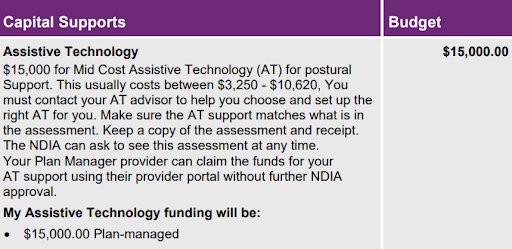
For the example above, the item that can be purchased is a Postural support device with a recommended maximum price of $10,620. The remaining funding can be used for other AT items.
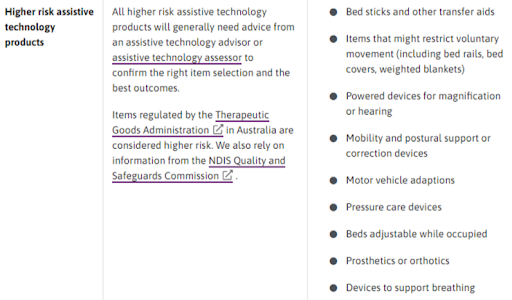
The item in this example requires an assessment, as explained in the plan. Most AT items require an assessment (see examples in the table below).
Some items will need a quote to be approved by the NDIS before you can purchase them. You can read more about Risk and Assistive Technology on the NDIS website.
 17 Specialised Disability Accommodation (SDA):
This PACE category SDA supports is a range of housing designed for people with extreme functional or high level needs. Usually it is a shared home with a small number of people or it can be living by yourself. SDA funding includes the cost of the home or building you live in, usually you will need to pay rent and other personal costs to live in SDA.
 19 Assistive Technology Maintenance, Repair and Rental:
This PACE category can be used for Minor repairs and Maintenance (up to $1500), Short term or extended rental and trials. Major repairs over $1500.00 a quote may be required to be submitted to the NDIS for approval. Claiming from this category needs to meet the AT Home Modification and Consumables Code Guide and use the most appropriate line item for the support.
 06 Home Modifications:
Capital Home Modification Supports can be used to make structural changes to a person's home to enhance accessibility and safety. This may include widening doorways, installing accessible bathrooms, or building ramps. Before proceeding with home modifications, you typically need an assessment by a qualified healthcare professional, often an occupational therapist or an accredited assessor. This assessment will determine the specific modifications needed to make your home more accessible and safe. Following the assessment, you'll receive a recommendation specifying the necessary home modifications. This document outlines the type of modifications required, their scope, and any specific details needed for the modifications to be effective.
You or your NDIS planner should obtain a quote from a registered NDIS provider for the proposed home modifications. The quote should include detailed information about the modifications, their cost, and any associated installation or construction costs. Once you have the quote, you or your NDIS planner should submit it to the NDIS for approval. The NDIS will review the quote to ensure it aligns with your goals, needs, and budget. Additional information may be requested if needed. After approval, the NDIS will allocate the necessary funding to your plan specifically designated for the approved home modifications.
funding is not flexible. More information is available in NDIA Pricing Arrangement and Limits
 |
07 Support Coordination: |
Support coordination is one of the services available to NDIS participants, and its primary purpose is to help individuals navigate the NDIS system, connect with appropriate supports, and manage their NDIS plans effectively. |
 |
08 Improved Living Arrangements: |
This support is to help you find and maintain an appropriate place to live |
 |
09 Increased Social and Community Participation: |
This category helps individuals become more involved in their communities and build social connections. It may include support for joining clubs, participating in social activities, or accessing community services. |
 |
10 Employment- Finding and Keeping a job: |
Capacity Building supports can assist individuals with disabilities in preparing for, finding, and maintaining employment. This includes services like job coaching, resume building, and workplace adaptations. |
 |
11 Improved Relationships: |
The NDIS Improved Relationships supports are for both long-term and more immediate intensive interventions to address behaviours of concern and improve communication skills. The goal is to develop positive behaviour, encourage social interactions, and build a strong support system. |
 |
12 Improved Health and Wellbeing: |
These supports aim to improve physical and mental health, including access to therapies, exercise programs, dieticians and mental health counselling. |
 |
13 Improved Learning: |
This category can be used for training, advice and help for you to move from school to further education such as university or TAFE. |
 |
14 Improved Life Choices: |
Plan Management - A plan manager processes and pays invoices on behalf of participants and families. Plan managers are provided funds from the NDIS and this is separate from other funding in a plan. Plan managers manage funding, processing claims and distributing funds to providers. |
 |
15 Improved Daily Living: |
This category encompasses a wide range of supports and services to address specific needs and goals related to daily living. Assessment, training or therapy. Below is a list of therapies with the requirements to be able to claim supports. |
|
20 Behavior Support: |
The NDIS Improved Relationships supports are for both long-term and more immediate intensive interventions to address behaviours of concern and improve communication skills. The goal is to develop positive behaviour, encourage social interactions, and build a strong support system. Will need to see what supports have been provided and line item codes for this category. |
Example of Therapies from Improved Daily Living and the requirements for the provider.
- Art Therapist - A person who is a Professional Member with the Australian, New Zealand and Asian Creative Arts Therapy Association (ANZACATA).
- Audiologist - A person who is either currently certified as an Audiology Australia Accredited Audiologist by Audiology Australia or as a Full Member as an audiologist with the Australian College of Audiology.
- Counsellor - A person who is either a member of the Australian Counselling Association or an accredited Registrant with the Psychotherapy and Counselling Federation of Australia.
- Developmental Educator - A person who is a Full Member of Developmental Educators Australia Inc.
- Dietitian - A person who is an Accredited Practising Dietitian with the Dietitians Australia.
- Exercise Physiologist - A person who is an accredited exercise physiologist with Exercise and Sports Science Australia.
- Music Therapist - A person who is an Active “Registered Music Therapist” with the Australian Music Therapy Association.
- Occupational Therapist - A person who has a current Australian Health Practitioner Regulation Agency (AHPRA) Registration as an Occupational Therapist.
- Orthoptist - A person who has current registration with the Australian Orthoptic Board.
- Physiotherapist - A person who has a current AHPRA Registration as a Physiotherapist.
- Podiatrist - A person who has a current AHPRA Registration as a Podiatrist.
- Psychologist - A person who has a current AHPRA Registration as a Psychologist.
- Rehabilitation Counsellor - A person who is a member of the Australian Society of Rehabilitation Counsellors Inc. or equivalent.
- Social Worker - A person who is a member of the Australian Association of Social Workers.
- Speech Pathologist - A person who is a Certified Practising Speech Pathologist (CPSP) as approved by Speech Pathology Australia.
- Other Professional - A person who is not one of the types of professionals listed above but who the provider considers to be an appropriate professional to deliver therapeutic supports in line with the NDIS Quality and Safeguarding Commission’s requirements for Therapeutic Supports.
18 Recurring Transport:
This PACE category is for participants who receive transport funding. This category is for General Transport. Eligible participants receiving this funding pro rata in their bank account on a fortnightly basis. This funding is only a contribution payment. This type of funding is to help individuals get to appointments, social activities, work, or any other places they need to go. This may include funding for taxis, public transportation.