Short Term Accommodation - Providers
Short Term Accommodation (STA)
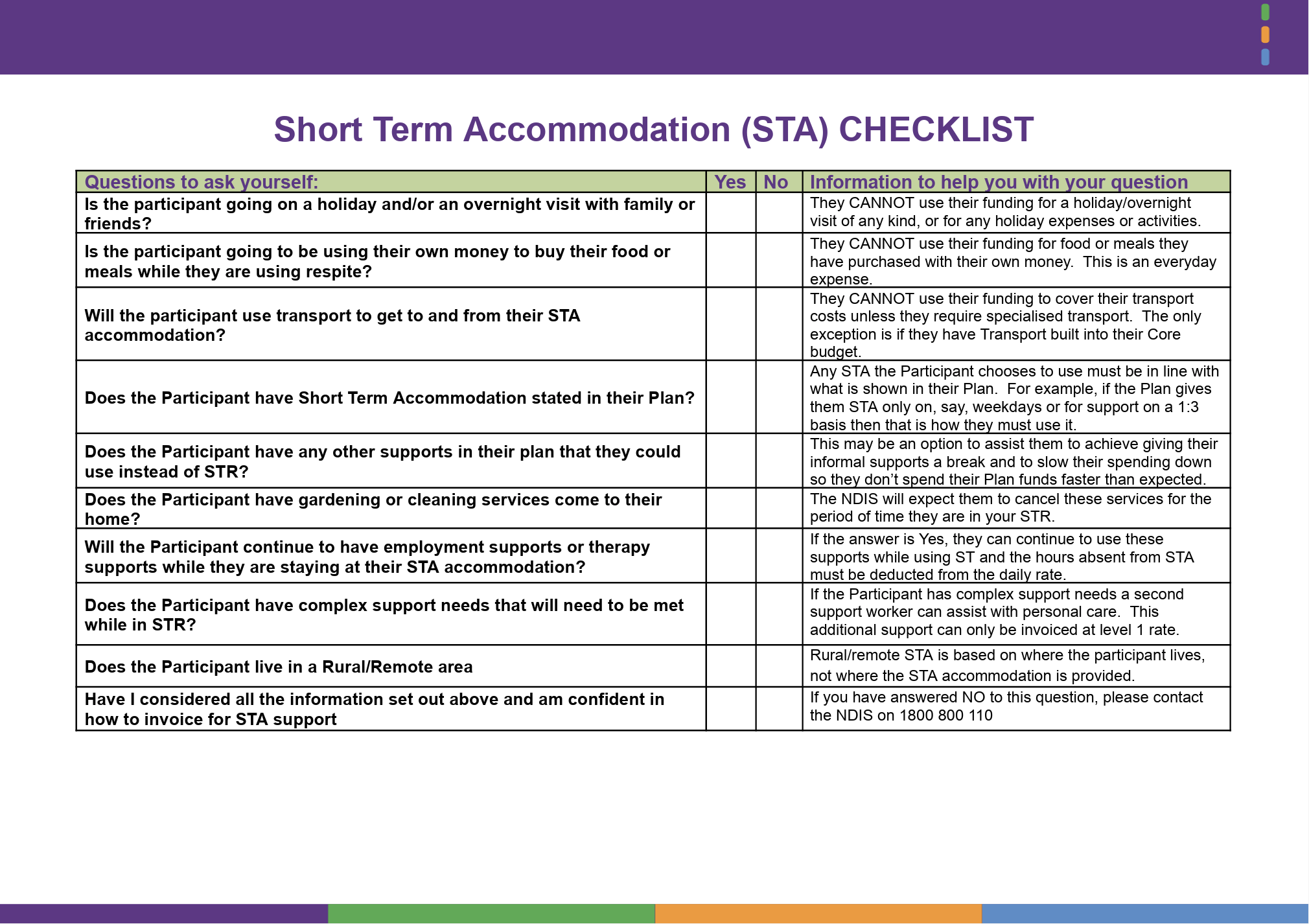
IMPORTANT: We recommend that you discuss with the Participant, prior to accepting a booking for STA, whether any specific STA has been set out in the Participant’s Plan.
We understand that not all providers provide Short Term Accommodation, however, it is important that all providers understand how STA works - what can and cannot be claimed for a participant who is staying in STA and what the NDIA expects.
The Facts
STA allows the Participant to have time apart, for at least one night, from their primary informal supports such as family and friends who give them the majority of their unpaid, active, disability-related support.
This provides the opportunity for them to be supported by someone else, while giving their family or friends a short break from their usual caring responsibilities. It lets the Participant try something else and helps them pursue their goals like increasing their independence or building their skills.
- STA needs to meet the NDIS reasonable and necessary criteria.
- STA is funded based on the level of support the Participant usually needs and the NDIA looks at evidence about their disability support needs that describe when and how often they need support.
- When STA is included in the Participant’s plan it is flexible funding in their Core budget. This means they will need to spend their funding in line with their plan.
- If the Participant chooses to use their STA funding for more support than they need, they may spend their funding faster than expected.
- If the Participant needs short term accommodation or if their needs have changed, they should talk to the NDIA representative.
The NDIS generally funds up to 28 days of STA per calendar year, for up to 14 days at a time. Sometimes a specific number of days of STA and support ratio (e.g. 1:3) will be set out in the Participant’s Plan.
The Participant can use their STA funding in a range of non-moving accommodation settings such as a respite facility, hotel, motel, short stay rental, cabin, cottage, homestay or their own home. It cannot be on a cruise or tour.
Generally, the Participant is expected to use STA in their home State or Territory in Australia. If they live in a remote or very remote area or a border town, they may be funded to use their closest STA in their neighbouring State or Territory.
If the Participant needs a support worker to stay at their STA location with them to access the level of support they need, the NDIS can also fund their accommodation. For example, if the Participant needs overnight supports, or there isn’t a local support worker near their STA accommodation. This means they can stay at the location and give the Participant the overnight support they need and usually get.
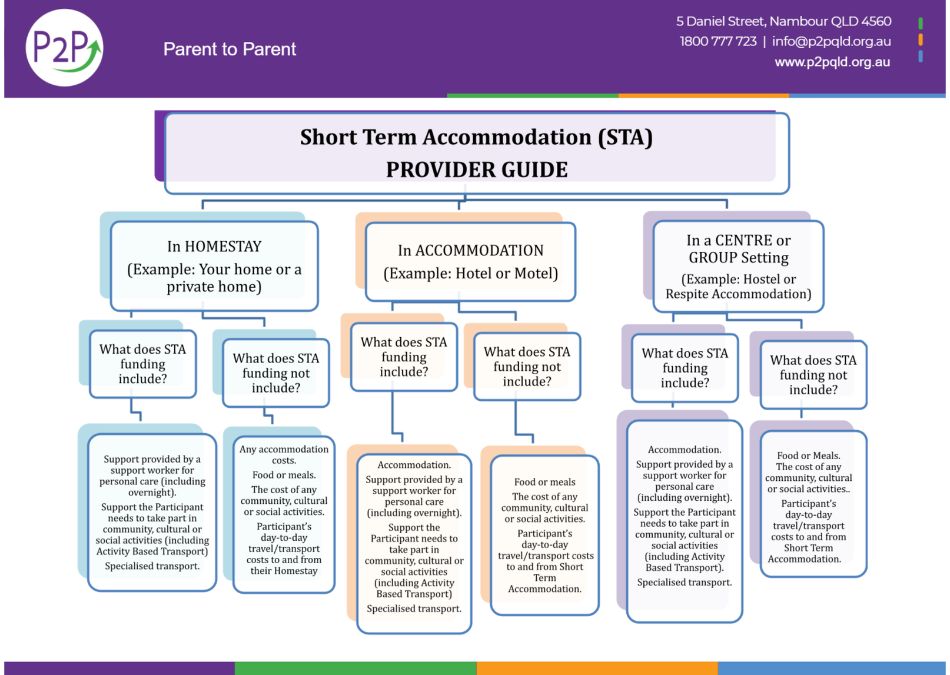
- Holidays - The participant can’t use it to go on a cruise or tour or holiday. It can’t be used for accommodation on holidays or airfares or other holiday or travel items, including interstate and overseas travel for holidays. It’s also not for the Participant’s family or friends to stay in accommodation or to attend programs.
- Transport - the Participant can’t use their STA funding to pay for transport to get to the short term accommodation or activity if they can travel or use public transport independently. If the Participant needs specialised transport this may be paid for. If the Participant’s plan includes separate funding for Transport, they can continue to use this funding to travel to and from their STA. The NDIS will not fund a claim for Activity Based Transport where the Participant’s carer did not stay and support them in their activity in the community.
- Meals - while the Participant is staying in short term accommodation, NDIS funding cannot be used to pay for food or meals. These are day-to-day living costs and are not NDIS supports.
- Activities - The Participant can’t use their NDIS funding to pay for activities, such as tickets, entry fees, equipment, or membership fees for themselves, their support worker or their family or friends.
- If the Participant lives alone independently and doesn’t have drop-in supports.
- The Participant gets more than 18 hours paid supports in their home each date, regardless of who they live with.
- The Participant is not having a break from their family or friends who they live with, or give them significant daily drop-in support.
- It’s a day-to-day living cost of the Participant that anyone is expected to pay, for example their mortgage, rent or utilities.
- The Participant is waiting for home modifications to be done.
- The Participant is living in a supported independent living (SIL) arrangement.
- The Participant has funding for primary or supplementary individualised living options.
- The Participant is in a housing crisis situation (if they are homeless or need somewhere to live they can contact homeless services in their State or Territory).
If the Participant is under 18 years of age, please consider the information contained in the NDIS Short Term Accommodation guide https://www.ndis.gov.au/media/8099/download?attachment
Short Term Accommodation (STA)
Additional Information
IMPORTANT: As of 01/07/2026 specific NDIS claim support item numbers are now available and required to be used when claiming for support hours for assistance with daily life and accommodation (participant and/or support worker) for support provided to the participant while in a short term accommodation stay.
The Facts
The correct NDIS Support line item and the ratio of support provided must be included on your invoice.
All support during an STA stay must be included on a single (1) invoice. Accommodation and supports cannot be invoiced separately.
A participant’s usual support worker cannot take the participant out of the STA facility for community participation, and then send a separate invoice for this. These invoices will be sent back to the providers to sort out invoicing for payment - they will need to discuss this with the family and the STA provider.
Your business may provide support to the participant at their home before they enter or after they leave the STA. If your invoice includes such supports, start and finish times for these supports and the STA should be included on the invoice to avoid any delay in processing and payment.
If you choose to work with another provider to provide the support during the participant’s STA stay you will need to arrange for a single provider to submit the invoice for STA - this provider will then pay the other provider(s) as negotiated.
The NDIA expects that all supports are provided by the STA provider.
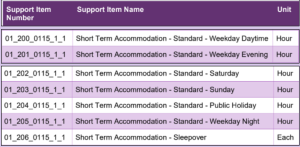
Effective from 01/07/2026, STA is no longer invoiced as an ‘all inclusive’ daily rate.
All support must be invoiced as per the NDIS Pricing Schedule 2026-27. Specific NDIS claim line items are available for support hours while in STA:
A flat rate for the accommodation component of STA support has been set out in the Pricing Schedule:

The NDIA does not set rates for supports, they just set and advise on the maximum allowed hourly (or daily) rate. All support rates can be negotiated by your clients/participants.
Community and social support and activities are invoiced in line with the usual NDIS 04-community support claim line items and hourly rates as negotiated by your clients/participants.
Where STA is delivered to a group of participants, the usual group support ratio rules apply when calculating your hourly rate for community support hours.
Activity Based Transport and provider travel can be claimed as an additional item, where applicable.
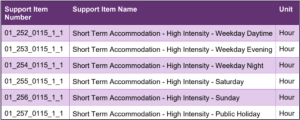
Where the participant has approval for Level 2 supports in their Plan, the following claim line items are available:
When a participant has approval in their NDIS plan for 2:1 supports:
- A second support worker can assist, when required, with assistance with self-care activities
- The second support worker could invoice separately, however, the appropriate support description and/or NDIS Support codes for additional support during STA would be required on their invoice
- This additional support can only be invoiced at level 1 rate
If a support worker stays at a participant's home for an extended support period, this may be classed as Short-Term Accommodation.
Invoicing for Short Term Accommodation support in the participant’s home should be in accordance with the NDIS Pricing Schedule and discussed and negotiated with the participant.
Rural/remote STA is based on where the participant lives, not where the STA accommodation is provided.
When not in a rural/remote area, the NDIA may review the distance from the participant’s home to where the STA support has been provided.
The NDIA expects an STA provider to not claim for any time spent by the Participant outside the STA environment for:
- Capacity building supports, including employment supports.
- Community support not provided by the STA provider
While in STA it is assumed by the NDIA that all support, excluding therapy and employment supports, that were to be provided at the same time as a participant is away from their home in STA have been rescheduled and would not take place during the participant’s STA support.
Anything else I need to know?
If you require more information or have further questions, please contact the NDIA at:
- NDIS enquiry phone line: 1800 800 110
- NDIS webchat: https://nccchat.ndis.gov.au/i3root/
Please note Parent to Parent is a registered NDIS provider, we are required to make sure that all invoice claims for participant NDIS funds follow the NDIS rules and regulations.
As the NDIS is conducting Payment Compliance reviews on an ongoing basis, we will be more vigilant about ensuring that invoices for supports for our clients meet the minimum requirements of the NDIS.
Provider Compliance – extract from the NDIS website:
Providers who deliver supports and services under the NDIS must operate and comply with relevant Australian laws, rules and regulations.
Not following the NDIS rules and regulations is non-compliance. This includes following the rules in the NDIS Pricing Arrangements and Pricing Limits and operational guidelines.
- Non-compliance can range from a simple mistake to criminal matters such as fraud. It can be accidental or deliberate.